|
||||||
|
Pictures of "
The "oriental type" - now with star and guiding angel - originated in the 5th century and has ever since been the familiar representation of the Virgin and Christ. The setting is that of a royal court. Noble visitors approach the throne of Mother and Child in a most devout manner, received by the angel, who has adopted the part of 'a master of ceremonies'. Later then, in the background Joseph, who has taken the role of a 'royal adviser'. Mary, Queen of Heaven, and Christ, the Redeemer, - both adorned with haloes now - have turned away from their visitors to look at us, the viewers. Franks Casket stems from this latter type, though it does not show an angel, but a big waterfowl instead. The star is rendered by a rosette. For no apparent reason a word in runes, magi, names the visitors, the Magi. This carving is one of the oldest pictures of this kind in an area (7th century Northumbria), partially still pagan.
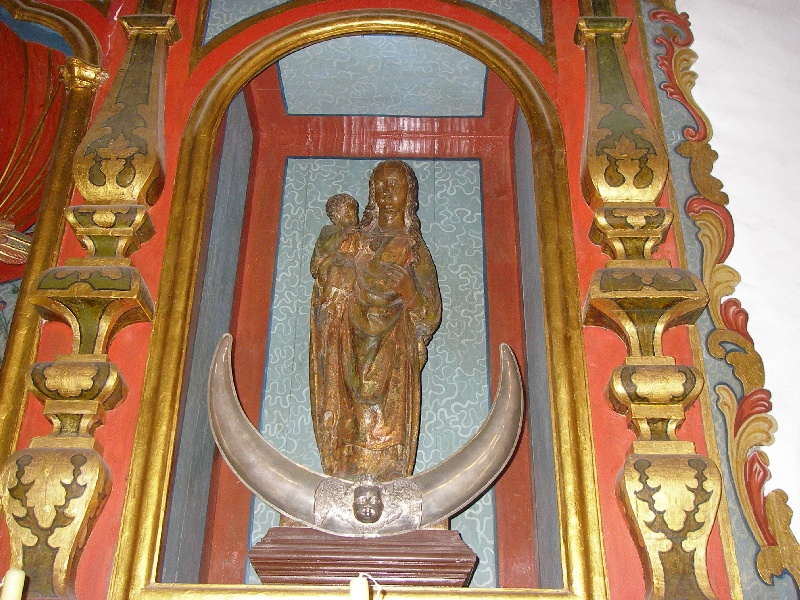
But this family unit "Mary and Christ" was preceded by a much older combination of "mother and child", which the Church partially eliminated, if they were obviously idols, or else partially replaced by Christian art, and in rare instances adopted as Christian art. Whether abandoned or adopted, all these deities had one thing in common, they represented the archetype of "Mother". Detested by the Church, many of them were destroyed or painted over with a lighter colour, but some of them survived in their 'black' form. We are talking about the "Black Madonna" figures, which seem to be much older than the "Holy Family".2 This pre-Christian goddess once represented a Mother Deity, symbol of marriage, sexuality and fertility and beyond that she was associated with birth and death; the vamp if you like. The Church did! The moon (once a goddess all by herself) became her attribute. The black night was one of her aspects, the bright moon another.
She was anything from "Mother Earth" Unloved by the Church she was. But they could not do away with her that easily. So they remembered the rule: "If cant beat it, join it." And they did. They put the birth of Christ on Dec. 25th and Epiphany (Adoration of the Magi) on Jan. 6th. If the pagans were having a good time anyway, it should be for the right object at least. But there was that crazy moon. People still kept venerating "her" and nothing could stop them. Finally Pope Innocence III (around 1200) allowed the association of Mary and Moon: " Anybody buried in the shade of sin should look up to the moon. After having lost the grace of God, there will be no day, no sun to shine on him, but there is still the moon above the horizon. Let her talk to Mary under whose guidance many find the right way to God." And we see her with the crescent of the moon under her feet. The opponent overcome.
Though Mary very soon attracted some features of the Mother goddess, she changed into the Heavenly Queen, the 'sterile'
If we trace her names we may begin with If we have a closer look at this scene on the casket, we realize some strange features. A trefoil knot in the left corner, a water bound bird, a runic inscription, mægi, a rosette with 13 leaves or rays, not 12 or 16, as one might expect. Why 13? Since the Magi are astrologers, it is very likely that this feature of the star bears a particular meaning. The "lunar" year, as a matter of fact, consists of a cycle of 13 lunar months (13 months of 27 days each result in one year of 355 days). Thus we may assume that the rosette actually stands for the moon, the symbol of the pagan goddess, Erta (Perchta, Berta etc.). This would mean that the Virgin here still bears features of her pagan counterpart. If so the bird, goose or swan (a pagan guardian spirit, a valkyrie) is put in place of the biblical guiding angel.
The reading of the programme starts out with this picture (birth) and continues from right to left (Wayland > Romulus > Titus) around the box, and it ends with the mythological scene of hHerh os and the warrior (death). Here and there we have a hidden goddess, Erta , and her instrument, the Valkyrie. Viewed like this the only genuine Christian topic on the casket, the adoration of the Mary and Jesus by the Magi, becomes fairly ambiguous with its traces of holy virgin and demonic vamp. As a matter of fact, the latter one has some qualities of the biblical Magdalena. In our context she assumes features of Mother Earth, of Erce, Erta or Hertha, maybe, an Old English Deity. 1 Details in Alfred Becker, 2 Numerous of such Madonna statues have been destroyed during the last 200 years, among others the one of Chartres, with its Notre-Dame-de-sous-Terre, once venerated in a crypt. Places where they still exist are among others Einsiedeln (Switzerland), Crotone (Italy) with a Madonna responsible for conception, pregnancy, labour and birth; Montserrat; Rocamadour, Dijon, 3 The name of Hera, the queen of the gods, admits a variety of mutually exclusive etymologies; one possibility is to connect it with hōra (ὥρα), season, and to interpret it as ripe for marriage. So begins the section on Hera in Walter Burkert's Greek Religion. In a note, he records other scholars' arguments "for the meaning Mistress as a feminine to Heros, Master." John Chadwick, a decipherer of Linear B, remarks ""her name may be connected with hērōs, ἥρως, 'hero', but that is no help, since it too is etymologically obscure." A.J. van Windekens, offers "young cow, heifer", which is consonant with Hera's common epithet βοώπις (boōpis, cow-eyed). E-ra appears in Mycenaean Linear B tablets. (from Wikipedia, Hera) |
||||||
|
||||||
|