|
||||||
|
The automatic translation is necessarily imprecise. This translation does not replace the reading of German or English original texts.
A Fatal Event with Happy End
This scene depicts a warrior's death, but it is certainly not our warrior, the "lord of the rings". It is rather some lost saga, which stands emblematically for the fate desired. Our hero is to face the same end as that forgotten brave man of the past.
If we see a relation between the segments of the picture and the three alliterating stanzas, the The snake around her head stands for her deadly duty, choosing the heroes for Valhalla. As it lives beneath the earth in the dark it is a symbol of death, and as it can shed the snake is a symbol for rebirth. It is a symbol for Odin as well, as he used to change into that shape and so it is he who speaks through that Valkyrie to that warrior.
From northern mythology we know that in his last combat the warrior faces his Valkyrie who paralyses him by her frightful appearance, so that he - aglac drigiÞ - can be felled by his foe. Woden's heroes would not lose, if it were not ordained. The features, the creature is composed of, point in that direction. Wings illustrate her fondness for changing into bird-shape (F-Panel, Magi), waterfowl in particular. Her deer-like features corresponds with the rune
The form of the rune
She acted, swa hir i erta e gisgraf „as Erta had imposed on her.“ If Erta is the "eorþan modor ", the Earth Mother , then the lines from the Runic Poem on the rune These ideas correspond with our picture. He has met his fate in the guise of a frightening monster, (agl(ac) drigiþ swa hir i erta e gisgraf, "she works fate, as Erta imposed on her"). As the outcome the warrior rests in his grave as shown in the middle section. There (left of the mound) we have a horse marked with two trefoils, ON. valknutr the Woden/Oðinn’s symbol. Tree runes, as shown below, comment on its nature. Above the mound we see a chalice and right of the mound a woman with a staff in her hand. She is his Valkyrie, who has left her seat and come to him in the shape of a bird. Now she is his beautiful sigwif, the hero's benevolent, even loving companion, who revives him with a drink from that chalice and takes him to Valhalla. The horse may be Sleipnir, Woden/Oðinn's famous stallion. This fate of a warrior, the death brought about him by his fylgja and her visit in his grave where she revives him with her love and the potent of eternal life, alu, is rendered in the Poetic Edda with "The Second Lay of Helgi Hundingsbane" (See below)
Let us have a closer look at the three tituli that are filled into this carving:
wudu could refer to the site, the "grove", which would make little sense as it is depicted, but can also be understood as the frequently used poetic name for "spear" (Pollington, Warrior ,
bita finally means "bite, stitch, wound" (often for a sword cut) and could also serve as a name of a spear. And if we have a close look at the lady by the grave, we realize that she is holding a wand, which blends into the rune The explanation for all this can be found in Germanic mythology. A hurled twig changes into a spear and kills the victim. Baldr was killed by a mistletoe wand that turned into a missile. We find a similar event in the Gautrekssaga, where a mock sacrifice was put up:
So it was Herh-os, who flung the fatal rush (risci) at him. It changes into a spear (wudu) and this weapon bit (bita) her chosen warrior. Now she is standing at his grave, the spear that she had flung as a twig firmly in her hand. She will take the hero from Midgard to Asgard.
As done above (R-Panel) we are having a closer look at the roots of the three trees. Right behind that doomed warrior we have a plant with 2 roots to the left and 2 others to the right
There is more to count! The warrior's body is resting on 11 little brick-like elements, certainly no shock absorbing filling of the mound. May be, they are slabs or sticks indicating the fate of a person. If so, their number could be the clue. 11 is the value of the i-rune
The right segment is separated by a cross-like symbol, which is likely to describe the Valkyrie, rather than the person next to her. The same symbol precedes the name Titus on the
It remains uncertain whether this scene goes deeper into transcendent regions, into the realms of ghosts and gods or whether it reports more of the lost saga. If so it could be an archer (if there is a bow depicted between him and the hooded figure on the right), the one who committed the deed, now arrested and led away. But hoods point to the other world from where even Woden comes hooded. Such compositions, two supernatural beings guiding or leading a human away, are fairly common, though we do not know much about their meaning. A key to that would be the interpretation of the objects, normally done away with as ornaments.
from “THE POETIC EDDA”, translated by HENRY ADAMS BELLOWS Sigrun went in the hill to Helgi, and said: 42. "Now am I glad | of our meeting together, As Othin's hawks, | so eager for prey, When slaughter and flesh | all warm they scent, Or dew-wet see | the red of day.
43. "First will I kiss | the lifeless king, Ere off the bloody | byrnie thou cast; With frost thy hair | is heavy, Helgi, And damp thou art | with the dew of death; (Ice-cold hands | has Hogni's kinsman, What, prince, can I | to bring thee ease?)"
Helgi spake: 44. "Thou alone, Sigrun | of Sevafjoll, Art cause that Helgi | with dew is heavy; Gold-decked maid, | thy tears are grievous, (Sun-bright south-maid, | ere thou sleepest;) Each falls like blood | on the hero's breast, (Burned-out, cold, | and crushed with care.)
45. "Well shall we drink | a noble draught, Though love and lands | are lost to me; No man a song | of sorrow shall sing, Though bleeding wounds | are on my breast; Now in the hill | our brides we hold, The heroes' loves, | by their husbands dead." Sigrun made ready a bed in the hill. 46. "Here a bed | I have made for thee, Helgi, To rest thee from care, | thou kin of the Ylfings; I will make thee sink | to sleep in my arms, As once I lay | with the living king."
Helgi spake: 47. "Now do I say | that in Sevafjoll Aught may happen, | early or late, Since thou sleepest clasped | in a corpse's arms, So fair in the hill, | the daughter of Hogni! (Living thou comest, | a daughter of kings.)
48. "Now must I ride | the reddened ways, And my bay steed set | to tread the sky; Westward I go | to wind-helm's bridges, Ere Salgofnir wakes | the warrior throng."
Then Helgi and his followers rode on their way, and [48. wind-helm: the sky; the bridge is Bifrost, the rainbow (cf. Grimnismol, 29). Salgofnir ("Hall-Crower"): the cock Gollinkambi who awakes the gods and warriors for the last battle.] |
||||||
|
||||||
|
 , (eolh, elk), a rune that accompanies Welund's Valkyrie, now in human shape, on the
 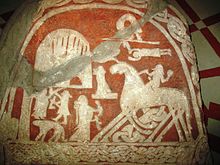 Picture Stone from Lärbro, Tjängvide, Gotland (Sweden).
 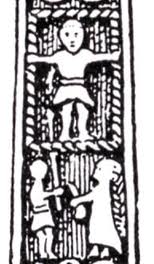 Gosforth Cross, Cumbria (Northumbria), England.
  ] Here the dead warrior (Jesus ?) receives his reviving draught from her drinking horn. In those pagan or early Christian days it was almost unthinkable that a king was nailed to the cross. A king would not be killed by man and then adored. If he had to die, then like Baldr by mistletoe, a twig that turned into a spear when flung. All the same what it was that caused his death, it was the spear of his Valkyrie which bore him down, not a sword or an axe, or even a nail to the cross. And this is what the picture shows, the Saviour killed by a spear, directed by his Valkyrie, and when he resurrects, then due to the draught from her horn, in our case rather mead or beer than red wine.
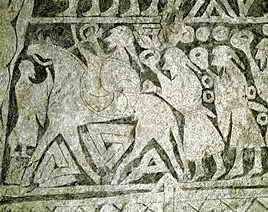 The parallels with our picture are obvious: Here too, we have the fatal encounter with a Valkyrie (Her-os) in her animal nature, here too the dead body, the Valkyrie with the fatal weapon, now in her human shape, ready to revive the hero with a drink from the chalice (instead of a horn), and – most important of all - here too, we meet the horse with the valknutr, identifying it as Odin/Woden’s Sleipnir.
 (EA) referring to ‘earth’ fit to the event here: “The Earth is horrible to every knight, when the corpse quickly begins to cool and is laid in the bosom of the dark earth. Property declines, happiness passes away and conveneants are broken,” Just as it is said by: “særden sorgæ and sefa tornæ” which refers to the “grief and distress” for those, who are left behind.
 , thus designating the Valkyrie florally, just as in the Welund picture. Also the Runic Poem points into this direction: "(the elk-sedge) ... grows in the water and makes a ghastly wound, covering with blood every warrior who touches it." It is also the kind of yew of which bows are made and it stands for the white swan (OED), one form of valkyrian appearance. But risci also means 'twig'

 thus forming a spear. This rune is associated with (ON) Tyr, (OE) Tiw the old Germanic sovereign ruler and god of warfare. Though replaced by Odin/Woden with his spear Gungnir, the spear shaped rune still bears his name.
 , which means - quite appropriately - need and threat.
  , which indicates danger of life and thus illustrates the situation very well.


